Watch on YouTube: youtu.be/F1DxxNNBoi8 ↗
01 — OverviewWhat Makes This Build Remarkable
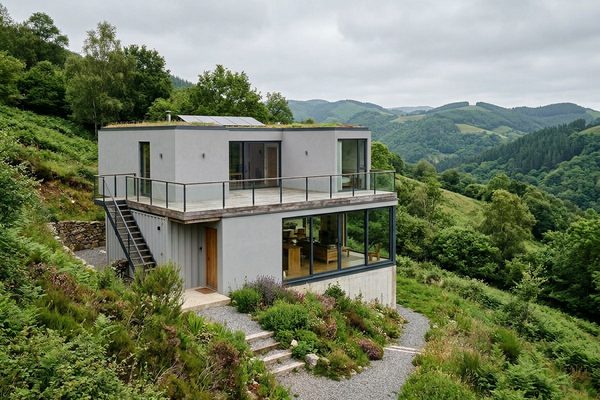
Eva and Rodrigo’s build stands out for one specific reason: no prior construction experience. A young couple from Cantabria, they completed a container home with a welded steel tube second floor, Plecoterm Integra facade, and a 150kg panoramic window — saving approximately $50,000 compared to conventional construction in their region.
The result is technically impressive for a first-time project. These are not features typically found on first-time DIY container builds, and the climate they built for — one of Spain’s wettest regions — raised the technical demands significantly.
02 — ClimateWhy Cantabria Changes Everything
Cantabria’s oceanic climate (Köppen Cfb) brings consistently high humidity, 1,000–1,800mm annual rainfall, and wind-driven rain as the primary structural weather challenge. This drove every key technical choice in the build — facade system, insulation method, and window specification.
The same build executed in Arizona and in Cantabria requires fundamentally different solutions. Eva and Rodrigo’s choices only make sense in the context of their specific climate. Builders in the Pacific Northwest, UK, New Zealand, or coastal northern Europe should apply the same climate-first logic.
03 — StructureSecond Floor, Steel Frame & Panoramic Window
The build uses a single 40-ft high cube container as the base, with a welded steel tube frame added to create a second level. Steel tube columns are welded to the container’s corner castings — the strongest structural attachment points on any container — and horizontal beams span between them to form the second-floor deck.
The 150kg panoramic front window required the entire family to coordinate its hoisting. A structural steel lintel above the opening carries the container wall load around the cut. The perimeter sealing must perform under constant rain exposure in Cantabria’s climate — marine-grade sealant and mechanical fasteners are non-optional here.
04 — FacadeThe Plecoterm Integra System
Rather than painting the container or using timber, Eva and Rodrigo selected Plecoterm Integra — a dry construction facade designed for metal substrates in demanding climates. Metal rails and pin connectors fix to the exterior with a deliberate gap creating a ventilated cavity, then mesh, base coat, and decorative render are applied over the grid.
| Cantabria Challenge | How Plecoterm Integra Responds |
|---|---|
| Constant rain and moisture exposure | Ventilated cavity drains any penetrating moisture before it reaches container steel |
| Thermal expansion of steel container | Separated grid allows container to move independently, preventing facade cracking |
| Corrosion risk on exterior steel | All container surfaces covered; no unprotected steel exposed to rain |
| Wind-driven rain penetration | Render system rated for Exposure Category III — high wind and rain |
The key principle: a ventilated cavity between a rigid facade and moving steel is non-negotiable in wet climates. Any facade bonded directly to steel without an air gap will crack as the container thermally cycles and will trap moisture against the wall.
Buy a Container for Your Build
For a build with a second floor and panoramic window, start with a one-trip (nearly new) 40-ft high cube. Browse current eBay listings with nationwide delivery.
Browse 40-ft High Cube Containers on eBay →05 — CostsThe $50,000 Saving — Where It Comes From
The saving is a comparison between what this DIY container home cost and what equivalent conventional residential construction would cost in Cantabria. Labor dominates Spanish construction costs; self-building captures most of that value directly.
| Category | Self-Build Est. | Contractor-Managed |
|---|---|---|
| Container (40-ft, low-use) | €2,500–€4,500 | €2,500–€4,500 |
| Second-floor steel tube frame | €4,000–€9,000 | €8,000–€18,000 |
| Plecoterm Integra facade | €4,000–€9,000 | €7,000–€15,000 |
| Spray foam insulation | €3,000–€6,000 | €4,500–€8,000 |
| Windows (inc. 150kg panoramic) | €6,000–€14,000 | €9,000–€20,000 |
| Interior fit-out | €8,000–€18,000 | €15,000–€35,000 |
| Architect and engineering fees | €3,000–€7,000 | €12,000–€22,000 |
| TOTAL ESTIMATE | €54,000–€113,400 | €97,000–€202,000 |
Blueprint Sets for Container Builds
A proper plan set addresses second-floor structural connections, window opening reinforcement, and facade integration before you start cutting steel.
Browse Blueprint Sets on Amazon →Key lessons from the Cantabria build
- Zero construction experience is not a disqualifier — but it requires knowing which tasks need professional execution. Structural welding, spray foam, electrical, and plumbing are professional-required in most jurisdictions.
- Climate is the most important facade selection variable. Plecoterm Integra’s ventilated cavity principle applies to any wet climate — Pacific Northwest, UK, New Zealand, or coastal northern Europe.
- The ventilated cavity is non-negotiable in wet climates. Any rigid facade bonded directly to steel without an air gap will crack seasonally and trap moisture.
- A second floor on a steel tube frame requires structural engineering input for local wind and live load conditions — both a safety requirement and a permitting necessity.
- The $50,000 saving is real — primarily because labor dominates Spanish construction costs and self-building captures most of that value directly.
- A 150kg panoramic window requires a team and a plan. The structural opening, lintel, hoisting mechanism, and sealing system must all be prepared before the window arrives.