Watch on YouTube: youtu.be/guufciJaug8 ↗
01 — Overview$20,000 for a Finished Container Home
The central achievement of Matt and Paiton’s build is not the finished home — it is the price. $20,000 for a completed, livable, aesthetically considered container home on a five-acre waterfront homestead in northern Washington State. Most container home builds in this space land at $40,000–$80,000. Getting to $20,000 required a consistent strategy applied to every purchase decision across a year-long build.
“I try to find it locally and cheap. I think that’s how we stayed around that twenty thousand dollar mark compared to those little forty thousand dollar houses you see.”
02 — The ContainerWhy a 45-Foot High Cube
Matt and Paiton’s selection of a 45-ft high cube is the first smart budget decision in the build. Less common than 20-ft and 40-ft units, the 45-footer has reduced buyer competition in secondary markets — often costing less than a standard 40-ft while providing 38 extra square feet of floor area.
| Spec | Standard 40-ft HC | 45-ft HC (Matt & Paiton) |
|---|---|---|
| Interior floor area | ~300 sq ft | ~338 sq ft (+38 sq ft) |
| Market availability | High demand; competitive pricing | Less common; often lower cost |
| Structural rating | Full residential use | Same rating |
Browse 40-ft and 45-ft Containers
Search eBay for 40-ft and 45-ft high cube containers in your region. Less buyer competition on 45-ft units often means better prices.
Browse Containers on eBay →03 — The StrategySalvage and Reclaim at Every Turn
The $20,000 total is achievable through one consistently applied principle: find it locally and cheap. Matt and Paiton applied this to every material category throughout the build.
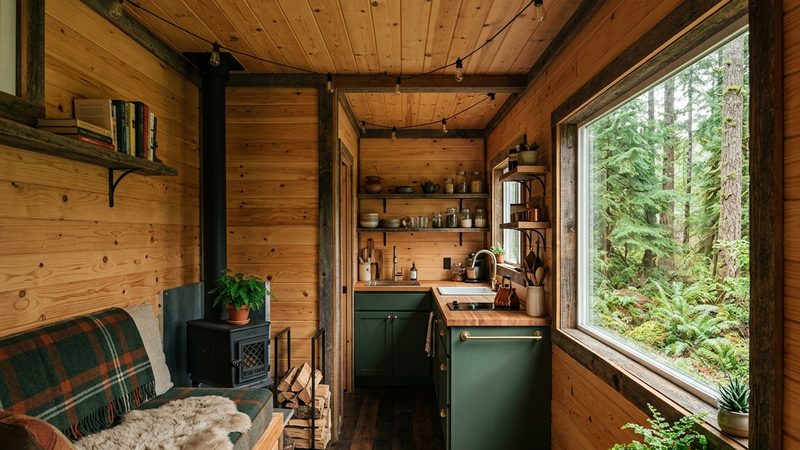
- Interior wall cladding: 3/4-inch tongue and groove pine — sourced locally via salvage, not retail (retail price would be 2–3× higher)
- Ceiling trim: reclaimed wood from a locally demolished building — old-growth timber that’s impossible to replicate at any new-material price
- General philosophy: for every material decision, the question was “what is available locally and cheaply that achieves the same function?” — not “what do I want?”
The salvage strategy requires network, flexibility, storage, time, and judgment. Building on salvage-first adds calendar time — Matt and Paiton’s one-year timeline reflects waiting for the right materials to become available rather than ordering everything on a compressed schedule.
04 — Financial Case$20,000 vs. Renting — The 10-Year View
| Metric | Renting a Local 1-Bedroom | Matt & Paiton Container Home |
|---|---|---|
| Monthly housing cost | Market rate | $300–$400 less per month |
| Equity building | Zero | Every payment builds equity in 5-acre parcel |
| Build cost amortized over 10 years | N/A | $20,000 ÷ 120 months = $167/month |
| Net advantage over 10 years (at $350/month savings) | Baseline | ~$22,000 ahead + land appreciation |
| Asset ownership | None | 5-acre Washington waterfront homestead |
05 — Cost BreakdownWhere the $20,000 Went
| Category | Estimated Cost | Sourcing Strategy |
|---|---|---|
| 45-ft high cube container | $2,500–$4,500 | Used; sourced locally in Pacific NW |
| Foundation (concrete pads/piers) | $1,500–$3,500 | DIY labor; concrete materials only |
| Insulation (spray foam) | $2,500–$4,000 | Professional — non-negotiable for Pacific NW climate |
| Windows and doors | $1,500–$3,500 | Mix of new and salvaged |
| Electrical | $1,500–$3,000 | DIY rough-in; licensed electrician for finals |
| Interior cladding (T&G pine, reclaimed wood) | $800–$2,000 | Salvage-sourced locally — key cost saving |
| Kitchen and bathroom fixtures | $500–$2,000 | Salvaged cabinetry; functional fixtures |
| TOTAL | ~$15,300–$30,100 | Midpoint ~$22,700; consistent with $20k at aggressive salvage |
Insulation for Pacific Northwest Builds
Closed-cell spray foam is non-negotiable in Washington State’s wet climate. Browse spray foam kits and rigid insulation on Amazon.
Shop Insulation on Amazon →Key lessons from the $20,000 Washington build
- The $20,000 number is real and reproducible — but only when the local-and-cheap strategy is applied to every material decision, not just a few. Builders who apply it selectively land at $35,000–$45,000.
- The 45-ft high cube is an underrated container choice. Less buyer competition means potentially lower cost than 40-ft units, with 38 extra square feet of floor area and the same structural and height advantages of the high cube format.
- Tongue and groove pine is the highest-value aesthetic investment on a tight budget. It costs more labor time than drywall but produces a warm, distinctive interior that reads as significantly more expensive than it is.
- Washington State waterfront properties require specific regulatory research before container placement. Shoreline Management Act setback requirements cannot be resolved after the container is on the ground.
- The skoolie-to-container progression is instructive. Prior alternative housing experience gave Matt and Paiton validated commitment, spatial problem-solving skills, and a realistic understanding of their actual daily needs.
- Paiton’s skill progression — from not knowing tool names to confident operation within the build timeline — is the honest answer to ‘no experience.’ Experience is the outcome of doing the build, not a prerequisite.