01 — OverviewWhy This Video Is Different
Most container home YouTube content falls into two categories: polished build reveals and aspirational tour videos. What is almost entirely absent is honest post-occupancy assessment — what it is actually like to live in a container home day after day, through all four seasons, after the novelty has worn off.
This video fills that gap. Published January 1, 2024 after one full year of living in a container home, Lucky Star Acres delivers an unfiltered account of what worked, what didn’t, and what the YouTube build community systematically understates. It is the video prospective container home builders should watch before any other.
Watch on YouTube: youtu.be/ttkGdFD_Lv0 ↗
02 — The FrameworkYouTube Narrative vs. 1-Year Reality
The video’s core structure contrasts the idealized container home narrative against the lived experience after 12 months of actual occupancy. This table is the most honest summary of the gap that exists between container home content and container home reality.
| Topic | YouTube Build Narrative | 1-Year Reality |
|---|---|---|
| Temperature | Mini-split handles everything | Thermal bridging through steel creates cold spots; extreme temps more challenging than expected |
| Noise | Rarely mentioned | Rain on steel roof is dramatically louder than a conventional home; hail is jarring |
| Condensation | Spray foam solves it | Any insulation gap creates condensation points; vigilance required year-round |
| Space | Clever design makes 300 sq ft feel spacious | 7.5 ft interior width never disappears; furniture choices permanently constrained |
| Timeline | Completed in months | Most honest timelines stretch to years; living during construction is harder than anticipated |
| Cost | Cheaper than conventional | True only with extensive DIY labor; materials + systems often match conventional cost |
| Resale | Not discussed | Difficult — limited buyer pool, no standard mortgage financing available |
| Permitting | Briefly mentioned | Ongoing relationship with building authorities; some jurisdictions require annual re-certification |
| Noise / neighbors | Rarely discussed | Community reactions range from curious to hostile; rural isolation is real |
| Psychology | Not covered | Narrow linear space requires genuine psychological adjustment that takes months |
03 — The IssuesWhat Container Home Videos Understate
Thermal performance — the gap between theory and practice
Every container home build video explains insulation confidently. The R-value is calculated, the spray foam is shown, and the problem is declared solved. The 1-year reality is more complicated.
- Steel is an exceptional thermal conductor. Any exposed steel — a missed spray foam pocket, a window frame touching the container wall, an uninsulated floor section — creates a cold bridge that condenses moisture no mini-split can eliminate
- The roof absorbs heat in summer and radiates cold in winter with startling efficiency. Under-insulated roofs create temperature stratification that makes upper living zones uncomfortable in extreme weather
- Mini-splits heat and cool the air — they do not address radiant cold from insufficiently insulated walls. A person near an under-insulated exterior wall feels cold even when the air temperature reads comfortable
- The fix: more insulation than you think you need. Designing to code minimum (R-13) in a steel shell is a miscalculation. Plan for R-25+ walls and R-40 roof
The insulation envelope must be treated as a complete, gap-free system — not a product you apply and consider finished. Every penetration, every seam, every junction must be addressed before occupancy. Condensation finds the weakest point.
Over-Insulate from the Start
Closed-cell spray foam kits, vapor barriers, and rigid foam rated for steel shell application. The one area where spending more upfront saves significantly later.
Shop Insulation on Amazon →Condensation — the quiet enemy
Condensation in a container home is not a dramatic failure — it is a slow accumulation that reveals itself months or years after occupancy. Common failure points include window frames, wall-to-floor junctions, electrical penetrations, and anywhere spray foam was applied too thin.
- Early warning signs: rust streaks on interior walls, musty smell in specific areas, paint bubbling, frost on interior surfaces in winter
- Prevention: continuous vapor barrier with zero gaps; treat every penetration as a potential condensation point before occupancy — not after
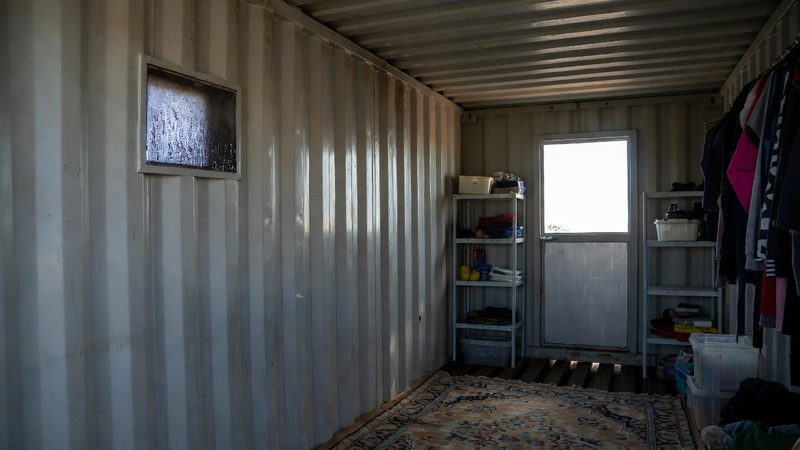
The width constraint — the reality of 7.5 feet
The 40-foot length gets celebrated in container home content. The 7.5-foot interior width — after framing and insulation from an 8-foot exterior — rarely receives equal attention. After one year, it emerges as the defining constraint of daily life.
- Standard furniture does not fit the same way. A sofa, coffee table, and TV in a 7.5-foot room leaves roughly 18–24 inches of walking space
- Two people cannot pass each other in the kitchen without coordinating — a minor inconvenience but a daily reality
- Activities requiring floor space — yoga, exercise, children playing — are impossible without reconfiguring
- Guests feel it immediately. Cozy for two occupants; noticeably tight for four
- The width never gets bigger. Unlike every other container home challenge, this one has no solution — only mitigation
Noise — the overlooked sensory reality
The acoustic properties of a steel box are dramatically different from a wood-framed home — almost never discussed in build content, and a genuine surprise to most first-year occupants.
- Rain on corrugated steel ranges from pleasant white noise in light rain to a genuinely disruptive roar in heavy rain or hail
- Wind on piers: a container on pier foundations can produce creaking and movement in high winds absent from slab-founded structures
- Mitigation must be built in: a proper roof assembly with air gap and acoustic underlayment, rugs, curtains, and soft furnishings. Planning to “add them later” is the most common acoustic regret
The psychological adjustment
No container home build video addresses the psychological experience of living in a narrow, linear, industrial-origin structure. The 1-year review is where this surfaces.
- The ‘box’ feeling is real. Some occupants adapt quickly; others find the confined linear space mildly oppressive, particularly during extended periods indoors in winter
- Window placement is the single most impactful factor in how a container home feels to live in. Generous, well-placed windows transform the experience
- Outdoor space is not optional. Container home dwellers who thrive consistently report a porch, deck, or yard that extends effective living area and provides psychological relief the interior cannot
- The novelty wears off within weeks. What remains is the practical reality of the space
04 — What WorksGenuine Strengths After One Year
The video is honest in both directions — not just cataloguing problems but acknowledging what the container home genuinely delivers after a full year of occupancy.
- Durability: a well-built container home weathers storms, wind, and precipitation with no drama. No rot, no termites, no structural degradation
- Thermal mass: in mild climates, the insulated shell holds temperature remarkably well once brought to comfort temperature, reducing HVAC cycling
- Security: steel structure with quality locks is meaningfully more secure than wood-framed construction
- Low-maintenance exterior: painted or coated steel requires minimal attention beyond periodic sealant and paint inspection
- Pride of ownership: occupants who built or designed their container home report high satisfaction with the creative accomplishment, independent of practical trade-offs
- Cost control potential: for owner-builders with genuine construction skills, a container home can cost significantly less than an equivalent conventional build — if labor substitution is honestly valued
05 — Do DifferentlyThe Would-Do-Differently List
The most valuable section of any post-occupancy review. These are the decisions most owners would revisit after 12 months of real living:
| Decision | What Was Done | What They’d Do Instead |
|---|---|---|
| Insulation spec | R-13 to R-19 (code minimum thinking) | R-25+ walls, R-40 roof — always over-insulate |
| Window placement | Functional placement | Maximize south-facing glazing; add skylights for vertical light |
| Acoustic treatment | Skipped — planned to add later | Include ceiling acoustic panels and roof assembly from the start |
| Outdoor space | Small deck added later | Design generous covered outdoor space as part of the original build |
| Furniture | Standard furniture | Select furniture specifically designed for narrow spaces from day one |
| Ventilation | Mini-split + operable windows | Add an HRV (heat recovery ventilator) for year-round fresh air without heat loss |
| Condensation | Spray foam + vapor barrier | Continuous vapor barrier with zero gaps; treat every penetration before occupancy |
| Interior finishes | Hard surfaces throughout | Add rugs, curtains, and soft surfaces early — they reduce noise and improve feel dramatically |
06 — Right FitWho Should — and Should Not — Build a Container Home
- Singles or couples who can adapt to the width constraint
- People with genuine construction skills who can execute insulation and waterproofing correctly
- Rural landowners wanting a durable, low-maintenance structure with a long time horizon
- Buyers with long-term ownership intent who won’t need to sell conventionally within 5–10 years
- People energized by the creative problem-solving aspects of an unconventional build
- Families with children needing multiple rooms and play space
- Buyers expecting to sell conventionally within a few years
- Anyone who hasn’t confirmed a clear permitting pathway first
- Anyone expecting the container shell to be the hard part — the systems are where builds succeed or fail
- Budget-constrained builders planning to ‘finish it later’ — incomplete systems stay incomplete
07 — TakeawaysWhat This Review Teaches Every Prospective Builder
6 lessons from a year of real living
- The 1-year review is the most important container home video format that barely exists. Build reveals show the best day of the project; post-occupancy reviews show the truth.
- Thermal bridging and condensation are not solved by the spray foam shown in build videos. They are solved by treating the insulation envelope as a complete, gap-free system — every penetration, seam, and junction.
- The 7.5-foot interior width is the constraint that never goes away. Every other container home challenge has a solution. Design and furnish for the width from day one.
- Outdoor space is the psychological escape valve of a container home. Build it before occupying — not afterward as a ‘phase 2’ that never happens.
- Rain noise is real and fixable — but only if addressed during the build. A proper roof assembly with air gap and acoustic underlayment is not an upgrade; it is a necessity.
- The container home format rewards honesty about trade-offs. Buyers who research real constraints and design to address them end up satisfied. Those who accept the YouTube narrative uncritically end up with the regrets this video documents.
Plan It Right Before You Build
A proper blueprint set addresses the insulation envelope, window placement, and condensation management before the first cut. Find permit-ready container home plans on Amazon from $29.
Browse Blueprint Sets on Amazon →See What a Finished Container Home Really Looks Like
Browse pre-built container homes on eBay — units that have already solved the insulation, HVAC, and condensation challenges, ready to deliver.
Browse Pre-Built Homes on eBay →