Watch on YouTube: youtu.be/1FiaFoEp4us ↗
01 — OverviewA Complete Off-Grid Shop from a Single Container
The Container Guy’s off-grid shop conversion is one of the most practically complete container modification tutorials available — it covers every major system required to make a shipping container into a functional, self-powered workspace in a single build. The project transforms a standard 20-ft container into an office and storage facility for an industrial site, operating entirely without a utility grid connection.
The defining principle is the no-weld philosophy: every modification uses bolt-on hardware engineered for container modification. No metalworking expertise is required at any stage. The build is accessible to anyone with basic hand tools.
The Container Guy explicitly calls out two tasks that should not be DIY despite the no-weld philosophy: spray foam insulation (requires professional equipment for correct application) and electrical wiring (requires a licensed electrician). Every other modification shown is DIY-accessible.
02 — The 7 SystemsWhat Was Modified and Why
| System | What Was Installed | DIY or Pro? |
|---|---|---|
| Entry door | Bolt-on container door system (Container Modifications World®) | DIY — bolt-on |
| Skylight vents | Roof-mounted skylight vents with integrated frames | DIY — bolt-on |
| Windows + covers | Side wall windows with protective security covers | DIY — bolt-on |
| Insulation | Closed-cell spray foam | PROFESSIONAL ONLY |
| Heating | Propane heater (indoor-rated) | DIY install; licensed propane connection |
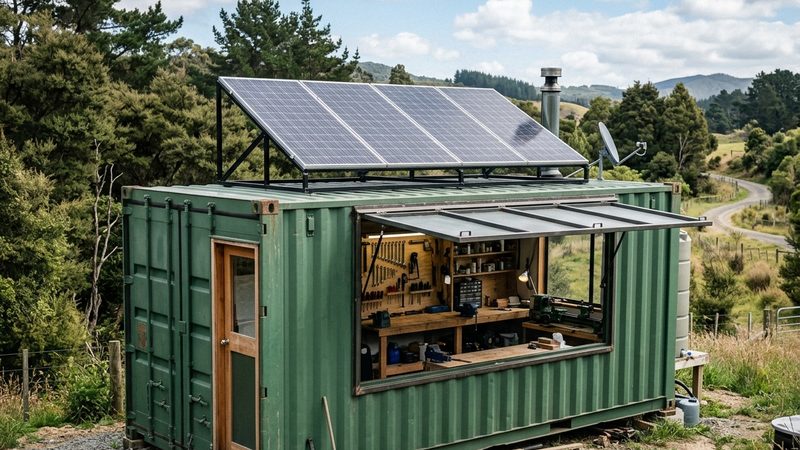
| Solar power | Solar panels + charge controller + batteries + inverter | DIY panel mount; Pro for wiring |
| Interior framing | Steel stud framing with bracket system | DIY — bolt-on brackets |
03 — The No-Weld DoorBolt-On Entry Without Metalworking
Installing an entry door intimidates most first-time builders because it involves cutting through the corrugated steel wall. The bolt-on door system eliminates the welding requirement that makes professional container modification expensive.
- Mark and cut the opening with an angle grinder and metal-cutting disc — minimum 32” wide × 80” tall; 36” × 80” preferred for shop use
- Install the bolt-on frame: flanges bolt to the container wall corrugations and adjacent structural members, distributing the door load across existing container structure
- Seal all perimeter gaps between frame and corrugated wall with spray foam or weatherstripping — primary weatherproofing for the opening
- Install a deadbolt or heavy-duty latch; the door is the most vulnerable access point on any converted container
04 — Skylight VentsLight and Ventilation Without Wall Openings
Skylight vents are one of the most overlooked additions to a container shop — and one of the most valuable. Roof-mounted vents simultaneously deliver natural overhead light and passive ventilation without sacrificing wall space for insulation, framing, or equipment mounting.
- Natural overhead light illuminates horizontal work surfaces from directly above, eliminating the shadows that side-mounted windows create on workbenches
- Passive convection: hot air rises and exits through roof vents while cooler air enters through door or wall openings; removes heat, fumes, and moisture without mechanical assistance
- Moisture management: a container shop that cycles through wet and dry conditions will rust tools and damage materials; roof vents combined with good insulation maintain a stable interior humidity
- Position skylights away from the container’s top rail corrugations for the cleanest cut surface; screen all openings to prevent debris entry
05 — Windows with Security CoversFunctional When Open, Secure When Closed
The windows combine two functions in one unit: natural light and ventilation during use, and steel panel protection against unauthorized access when unoccupied. When closed, the covers present the same visual profile as the container wall — no glass visible, no indication of what’s inside. When open, the covers fold back as rain awnings, shielding the opening from direct rain while allowing ventilation.
For shop placement: cross-ventilation windows on opposite walls; bench-height windows (4–5 ft from floor) maximize wall space below for shelving while providing useful light.
06 — InsulationThe One Step That Must Be Professional
Closed-cell spray foam is a two-component chemical system that requires professional proportioning equipment, heated hoses, and correct spray technique. Incorrect application produces foam with poor adhesion, insufficient R-value, and potential off-gassing of unreacted chemicals into the habitable space. DIY kits cannot produce even, complete coverage for a full container.
| Surface | Min. Thickness | R-Value | Priority |
|---|---|---|---|
| Roof / ceiling | 3–4 inches | R-18 to R-28 | Highest |
| Walls (all four) | 2–3 inches | R-12 to R-21 | High |
| Floor deck | 1.5–2 inches | R-9 to R-14 | Medium |
| Door & window frame perimeters | Fill completely | Continuous | High |
Container Insulation on Amazon
Closed-cell spray foam for the DIY-accessible portions of your build — frame perimeters, corrections, and top-ups after professional application.
Shop Insulation on Amazon →07 — Propane HeatingWhy Not Electric for Off-Grid
Propane heating is the natural complement to solar power in an off-grid shop: solar covers all electrical loads, and propane covers the one load that would otherwise overwhelm most small solar systems — space heating.
| Factor | Propane Heater | Electric Space Heater (off-grid) |
|---|---|---|
| Solar/battery requirement | None — fully independent | 1,500W heater needs ~125Ah battery capacity per hour |
| Cold weather performance | Full output at any temperature | Solar produces less in winter; batteries lose capacity below freezing |
| Cost to heat 160 sq ft/hr | ~$0.10–0.30 | $0.30–0.60+ (factoring battery replacement cost) |
| CO safety | CO risk in enclosed spaces — CO detector MANDATORY | No combustion; no CO risk |
A CO detector is mandatory in any container with a propane heater — not optional. Ensure adequate ventilation: a vent near floor level for fresh air intake and a skylight or wall vent for exhaust. Use only indoor-rated propane heaters (Mr. Heater Big Buddy or equivalent). Never leave a propane heater running unattended in an enclosed container.
08 — Solar PowerSizing the System Right
A properly sized solar system provides reliable power for lighting, tool charging, and electronics. Here’s a realistic load estimate for a working container shop:
| Load | Watts | Hours/Day | Daily Wh |
|---|---|---|---|
| LED shop lights (4 × 20W) | 80W | 4 hrs | 320 Wh |
| Phone / laptop charging | 60W | 2 hrs | 120 Wh |
| Power tools (intermittent) | 200–500W peak | 0.5 hrs | 100–250 Wh |
| Battery tool charger | 200W | 1 hr | 200 Wh |
| Radio / fan | 20–60W | 4 hrs | 80–240 Wh |
| TOTAL | — | — | 820–1,130 Wh/day |
Practical system spec for a 20-ft container shop: 400–600W solar panels (2–3 panels), 100–200 Ah LiFePO4 batteries, 40–60A MPPT charge controller (not PWM), 1,000–2,000W pure sine wave inverter (not modified sine). Electrical wiring by a licensed electrician.
09 — CostsComplete Off-Grid Shop Bill of Materials
| Category | Cost Range | Notes |
|---|---|---|
| Container (used 20-ft WWT) | $2,000–$4,500 | Delivered; WWT grade adequate for shop use |
| Bolt-on entry door kit | $400–$800 | Container Modifications World® |
| Skylight vents (2 units) | $400–$1,000 | $200–$500 per unit |
| Windows with covers (2–3) | $300–$1,200 | $150–$400 per window |
| Spray foam insulation (pro) | $800–$2,000 | Licensed contractor; non-negotiable |
| Propane heater + CO detector | $110–$260 | Indoor-rated unit only |
| Propane tank + regulator | $150–$300 | 100 lb tank; licensed connection for wall-mount |
| Solar panels (400–600W) | $300–$750 | $150–$250 per 200W panel |
| MPPT charge controller | $80–$200 | Victron, Renogy; MPPT required |
| LiFePO4 battery bank | $300–$800 | 100–200 Ah; avoid lead-acid |
| Pure sine wave inverter | $150–$400 | 1,000–2,000W; pure sine only |
| Electrical wiring (licensed) | $400–$1,200 | Professional required |
| Steel stud bracket kit (40-bracket) | $150–$300 | amzn.to/3TIDbji |
| Steel studs + wall cladding | $260–$650 | 1-5/8” studs + plywood or PVC panels |
| Hardware and fasteners | $50–$100 | Self-tapping screws, misc. |
| TOTAL | $5,650–$14,460 | DIY labor throughout; pro spray foam and electrical included |
Buy a 20-ft Container for Your Off-Grid Shop
Browse used 20-ft shipping containers on eBay with delivery to your location. WWT condition is adequate for shop and workshop builds.
Browse 20-ft Containers on eBay →Steel Stud Framing Brackets on Amazon
Container Modifications World® 40-bracket kit — bolt-on installation, no welding, accommodates both steel and wood studs.
Shop Framing Brackets on Amazon →Key lessons from The Container Guy’s off-grid shop
- The no-weld philosophy makes a complete off-grid shop accessible to anyone with basic hand tools. Bolt-on systems for doors, windows, vents, solar mounting, and framing eliminate the metalworking barrier that makes professional container conversion expensive.
- Spray foam and electrical wiring are the two right exceptions to the DIY approach. Both require professional equipment or licensed certification to execute correctly. Skimping on either undermines the entire build.
- Propane heating and solar power are natural partners in an off-grid shop. Solar covers all electrical loads; propane covers heating without overwhelming the solar system. All-electric off-grid heating is impractical at most solar system sizes.
- Skylight vents serve two functions simultaneously — light and ventilation — while preserving all four walls for insulation, framing, and equipment mounting. For a shop, roof-mounted skylights are more functional than wall windows for most work scenarios.
- A CO detector is mandatory in any enclosed container with a propane heater. This is not a suggestion. Use only indoor-rated heaters, ensure ventilation, and never leave the heater running unattended.
- Steel studs, not wood, are the correct framing specification for any occupied container. An industrial site environment with moisture and temperature cycling points toward non-organic framing that will not degrade or harbor mold.
- The $5,600–$14,500 total for a complete solar-powered, insulated, heated, and framed off-grid container shop represents exceptional value. The Container Guy’s build demonstrates that this cost is achievable with bolt-on systems and self-build labor.