A 40-ft high cube shipping container provides 320 square feet of private training space — enough for a power rack, cable station, full dumbbell set, cardio equipment, and mirror wall. Corten steel construction is stronger than any wood-framed outbuilding, lockable with commercial-grade door rods, and available used for $3,500–$6,500. The full luxury build costs $15,000–$35,000. At $600–$1,500/year for a commercial gym membership, the math favors ownership within 13–20 years — and you keep the asset.
01 — Container SelectionSize, Grade & What to Buy
| Type | Usable Interior | Ceiling (after insulation) | Gym Suitability | Used Cost |
|---|---|---|---|---|
| 20-ft Standard | ~145 sq ft | 7’4”+ | Minimalist solo gym; 2–3 equipment categories | $1,500–$5,000 |
| 20-ft High Cube | ~145 sq ft | 8’4”+ | Better overhead clearance; pull-ups and wall ball possible | $2,000–$5,500 |
| 40-ft Standard | ~290 sq ft | 7’4”+ | Full home gym with multiple zones | $3,000–$6,000 |
| 40-ft High Cube ★ Best | ~290 sq ft | 8’4”+ | Best for luxury gym — extra foot transforms the feel; overhead work fully unrestricted | $3,500–$6,500 |
Used vs one-trip: For a luxury build with $15,000+ of fit-out, spend the extra $1,000–$2,000 for a one-trip or well-graded WWT container. Inspect before buying — check for through-rust on ceilings, soft or chemically contaminated floor boards, and smell the interior with the doors closed. A container that carried pesticides or solvents may be unusable for a workout space regardless of structural condition.
Browse 40-ft High Cube Containers on eBay
Filter by condition and location. One-trip and cargo-worthy units available with delivery to your site.
Browse 40-ft High Cube Containers →02 — Rust Treatment & Exterior PaintPrep Before Any Interior Work
Exterior condition must be addressed before interior insulation begins. Insulation applied over a compromised exterior traps moisture and accelerates internal corrosion. Corten steel’s surface rust patina is usually cosmetic; through-rust (actual holes) must be repaired.
| Rust Type | Severity | Treatment |
|---|---|---|
| Surface rust / oxide patina | Cosmetic only | Wire brush or grind to bright metal; zinc-rich primer; DTM topcoat or leave as natural Corten patina |
| Pitting rust | Moderate — address before interior work | Grind to clean metal; rust converter on remaining staining; zinc-rich primer; fill deep pits with weld or epoxy; topcoat |
| Through-rust (perforations) | Serious — must repair | Cut out affected area; weld in steel patch of equivalent gauge; grind smooth; prime and paint |
| Corner post corrosion | Critical if structural | Remove corner caps; inspect interior; consult structural engineer if post is compromised |
Best exterior paint system: DTM (Direct-to-Metal) epoxy such as Rust-Oleum 9100 Series. Bonds directly over light rust, 2 coats minimum, 10–15+ year life. For coastal or high-humidity locations, step up to a zinc-rich primer + epoxy topcoat two-coat system for 15–20+ years.
03 — InsulationThe Most Critical Decision
An uninsulated container reaches 140°F+ interior temperature in direct summer sun — a genuine health hazard during intense training. Condensation from temperature differentials promotes mold and corrosion. Proper insulation solves temperature, HVAC efficiency, and condensation simultaneously.
| System | R-Value/in | Condensation Control | DIY? | Best For |
|---|---|---|---|---|
| Closed-cell spray foam ★ | R-6 to R-7 | Excellent — vapor barrier built in; fills all gaps | No — professional equipment | Best overall for container gyms; 2” min, 3” preferred on all surfaces |
| Rigid XPS/polyiso board | R-5 to R-6.5 | Good if sealed | Yes | Floor insulation; budget builds; supplement to spray foam |
| Rockwool / mineral wool batts | R-3 to R-4.2 | Moderate (requires vapor barrier) | Yes | Within framed stud walls after foam perimeter seal; excellent acoustic performance — critical for a gym |
| Open-cell spray foam | R-3.5 to R-4 | Poor — permeable | No | NOT recommended for metal structures — moisture passes through to steel |
Layer 1: 2–3” closed-cell spray foam on all interior steel surfaces (walls, ceiling, floor framing). Non-negotiable foundation layer. Layer 2: 1–2” rigid foam on floor before finished flooring. Layer 3 (optional): Rockwool batts in any additional framed wall cavities for acoustic dampening. Combined R-18 to R-26 — excellent for any US climate zone.
Insulation for Container Gym Builds
Closed-cell spray foam and rigid insulation. Professional application required for spray foam; rigid board is DIY-friendly for the floor layer.
Shop Insulation on Amazon →04 — ElectricalService Size, Circuits & Luxury Lighting
| Component | Power Draw | Circuit Required |
|---|---|---|
| Mini-split HVAC (12,000 BTU) | 900–1,500W running | Dedicated 20A 240V |
| Treadmill (commercial-grade) | 1,500–3,000W | Dedicated 20A 120V (some 240V) |
| LED lighting (full 40-ft) | 200–400W | One or two 15–20A circuits |
| Industrial ceiling fans (2) | 100–200W | Lighting or general circuit |
| Sound system / TV | 100–300W | General circuit |
| Refrigerator (drinks) | 100–200W | Dedicated 15–20A preferred |
| Peak load estimate | 3,500–5,500W | Minimum 50A subpanel; 100A for full flexibility |
Run a dedicated 50A minimum — 100A is better and the cost difference is primarily the panel and breaker. The trenching and conduit work is the same either way. Always trench for the larger service. Wire all circuits in EMT conduit for protection against equipment impacts.
Luxury lighting
- Primary: High-output LED shop lights or linear fixtures at 5000–6500K (cool daylight) — 50–80 lumens per sq ft for lifting areas
- Accent: LED strip lighting (RGB or tunable white) behind mirrors, under equipment zones, perimeter definition — run in aluminum channel for heat management
- Smart controls: Lutron Caseta or Philips Hue — program scenes: “morning session” (bright daylight), “evening grind” (warm, pumped-up), “recovery” (dim, warm)
05 — HVAC & VentilationClimate Control for Intense Training
A person exercising intensely produces 300–600 BTU/hour of heat and up to 2 liters of perspiration per hour. In a sealed container with 2–4 people training, heat and humidity buildup without active climate control creates genuine heat exhaustion risk in summer. HVAC is non-negotiable.
| Container Size | Insulation Level | Recommended Mini-Split | Notes |
|---|---|---|---|
| 20-ft container | Well-insulated (R-18+) | 9,000 BTU (¾ ton) | Add 1,000–2,000 BTU for intense multi-person training; 12,000 BTU provides comfortable headroom |
| 40-ft container | Well-insulated (R-18+) | 12,000–18,000 BTU (1–1.5 ton) | 12,000 BTU minimum; 18,000 for hot climates, multiple users, or if treadmill generates significant heat |
| 40-ft container | Minimal insulation | 24,000+ BTU (2 ton) | Poor insulation dramatically increases HVAC demand; fix the insulation, not the HVAC size |
Ventilation additions: Mini-split handles temperature and humidity; supplement with (1) two industrial ceiling fans on variable speed for airflow during training; (2) a small ERV (Energy Recovery Ventilator) or exhaust fan for fresh air exchange — one person training hard can deplete oxygen noticeably in a sealed 40-ft container within an hour.
06 — FlooringThe Foundation of Every Workout
Gym flooring must absorb impact, protect equipment and the container floor, resist moisture from perspiration and cleaning, and feel good underfoot during long sessions. The layered approach solves all requirements:
| Layer | Material | Thickness | Purpose |
|---|---|---|---|
| Base (thermal) | Rigid XPS foam board | 1” | Thermal break between steel frame and finished floor; dramatically improves cold-weather underfoot comfort |
| Sub-floor | 3/4” OSB or plywood (if replacing original) | 3/4” | Structural flat surface for finished flooring |
| Primary (most areas) | 3/8” or 1/2” thick rubber gym tiles (4’×4’ or 2’×2’ interlocking) | 3/8”–3/4” | Impact absorption, equipment protection, anti-slip, easy replacement of damaged tiles |
| Deadlift/drop zone | 3/4” or 1” stall mats (horse stall mats) — 4’×6’ rubber sheets | 3/4”–1” | Maximum impact absorption under power rack and barbells; most cost-effective heavy-use flooring per sq ft |
| Cardio zone (optional) | Vinyl plank or LVP over rubber base | 1/4”–3/8” | Easier to clean and maintain in cardio areas; cleaner aesthetic; waterproof |
07 — Walls, Ceiling & MirrorsThe Luxury Finish Layer
Wall finish options
| Option | Look | Cost | Notes |
|---|---|---|---|
| Painted spray foam (no cladding) | Industrial; foam texture visible | Lowest | Fastest and cheapest; spray foam painted with elastomeric paint; not the most polished look but perfectly functional |
| FRP (Fiberglass Reinforced Panels) | Clean white; institutional | Low–moderate | Easy to clean; moisture-proof; installs over spray foam; common in commercial gyms for exactly this reason |
| Drywall / plaster over studs | Residential; polished | Moderate | Standard home finish quality; requires proper vapor management; screws into steel studs; primed and painted |
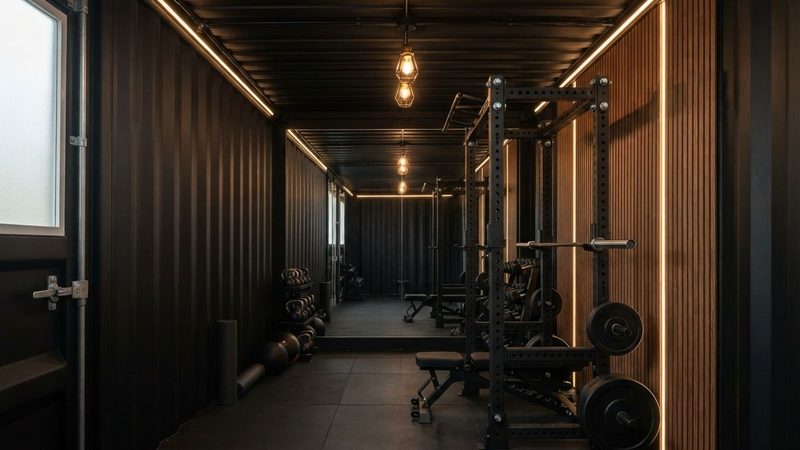
| Wood slat wall panels | Premium; warm industrial | Higher | The luxury choice — horizontal wood slats on a dark backing create a premium aesthetic that photographs dramatically |
| Exposed painted spray foam + accent wall | Industrial with focal point | Moderate | Paint all foam surfaces dark (charcoal or black); create a single feature wall in wood slat or tile; best of both worlds |
Mirror wall
A full mirror wall on one end of a 40-ft container is not optional in a luxury gym — it doubles the perceived size of the space, provides form feedback, and is the single finish detail that most elevates a container gym from utilitarian to premium. Options: gym-grade acrylic mirror panels (shatterproof; lighter weight; easier to install; slight color shift vs glass), standard glass mirror panels (truest color; heavier; breakage risk in a gym environment), or full-length frameless glass mirror tiles. Mount with mirror mastic on a flat wall surface; never directly to corrugated steel without a backing substrate.
08 — EquipmentZone Planning for a 40-ft Container
Plan zones first, equipment second. In a 40-ft container (nominally 40’×8’, working interior ~37’×7’2” after framing), four zones work well:
- Zone 1 — Strength (12’): Power rack + barbell + weight storage. A squat rack with attached weight storage keeps this zone compact. Allow 3’ rear clearance behind the bar for safety.
- Zone 2 — Cable / functional (8’): Functional trainer or cable crossover. Wall-mounted cable systems save significant floor space vs freestanding dual-stack.
- Zone 3 — Cardio (10’): Treadmill or rower or bike. One primary cardio piece and one secondary (echo bike folds partially; rower stores vertically against wall).
- Zone 4 — Free weights / stretching (7’): Dumbbell rack (wall-mounted or compact A-frame), pull-up station, stretching mat, foam rolling area.
| Category | Recommended Spec | Approx. Cost |
|---|---|---|
| Power rack / squat stand | Rogue RML-490C, REP PR-4000, or equivalent; integrated j-hooks, band pegs, plate storage | $600–$2,000 |
| Barbell + plates | 20kg Olympic barbell; 300–400 lbs bumper plates for clean/deadlift; iron plates for static work | $400–$1,200 |
| Functional trainer / cable machine | REP FT-100 or Inspire FT2; dual weight stacks; adjustable height; 200+ exercises | $1,500–$4,000 |
| Dumbbells | Adjustable (Bowflex 552 or 1090) saves floor space; or fixed hex set 5–75 lbs in wall rack | $400–$2,500 |
| Cardio (primary) | Concept2 RowErg (storable vertical) or commercial-grade treadmill; assault/echo bike for HIIT | $900–$3,000 |
| Wall-mounted pull-up bar | Mounted directly to container side rail or framed wall at 7’+ height; leave 18” minimum above bar | $50–$300 |
09 — Luxury Finishing TouchesWhat Separates Good from Great
- Sound system: In-ceiling speakers or wall-mount Sonos Era 100; waterproof rating important for moisture-heavy environment; integrate with smart home controls
- TV or display: 55”–75” display mounted above mirror or on end wall opposite entrance; keeps cardio sessions engaged; cable management in-wall
- Branded wall art / motivation: One or two large-format prints or vinyl graphics; dark color schemes work exceptionally well against charcoal or wood-slat walls
- Mini fridge or beverage cooler: Compact 2–4 cubic foot under-counter unit; cold water and recovery drinks on-demand; significant quality-of-life upgrade
- Chalk bucket holder / chalk station: A mounted chalk bucket holder keeps chalk contained; essential for serious strength training
- Floor-to-ceiling bag mount: Wall-mounted heavy bag bracket; hook and chain; eliminates need for freestanding stand; anchors into container side rail or reinforced stud wall
- Custom logo mat: Personalized entrance mat or custom-logo rubber floor tiles; available from many gym flooring suppliers; inexpensive way to give the space identity
- Exhaust fan timer: A timer-controlled exhaust fan that runs 10–15 minutes after training ends removes residual humidity; prevents overnight moisture accumulation
10 — Full Budget BreakdownThree Build Levels
| Category | Budget Build | Mid-Range Build | Luxury Build |
|---|---|---|---|
| Container (40-ft, used WWT) | $3,000–$5,000 | $4,000–$6,000 | $5,500–$8,000 (one-trip) |
| Delivery + placement | $500–$1,500 | $500–$1,500 | $500–$2,000 |
| Rust treatment + exterior paint | $200–$600 | $600–$1,200 | $1,200–$3,000 (pro) |
| Insulation (spray foam + rigid board) | $1,500–$2,500 | $2,500–$4,000 | $4,000–$6,500 |
| Electrical (50A subpanel + circuits) | $1,000–$2,000 | $2,000–$4,000 | $3,500–$6,000 (100A) |
| HVAC (mini-split 12–18k BTU) | $800–$1,500 | $1,500–$2,500 | $2,500–$4,000 |
| Flooring (rubber tiles + stall mats) | $400–$800 | $800–$1,800 | $1,800–$3,500 |
| Walls + ceiling finish | $200–$500 | $800–$2,000 | $2,500–$6,000 (wood slats + drywall) |
| Mirror wall | $300–$600 | $600–$1,500 | $1,500–$3,500 (frameless glass) |
| Lighting | $150–$400 | $400–$1,000 | $1,500–$3,500 (smart + accent) |
| Equipment | $2,000–$5,000 | $5,000–$12,000 | $12,000–$25,000 |
| Luxury finishes + misc | $0–$500 | $500–$1,500 | $2,000–$5,000 |
| TOTAL | $10,050–$19,900 | $19,200–$39,000 | $38,500–$76,000 |