Watch on YouTube: youtu.be/KbZsGl8EDQY ↗
The Great Home Ideas “Ultimate Budget” episode is the sharpest financial case study in the container home YouTube genre. Jason and a determined homeowner build a complete, livable single-container home for $45,000 AUD — approximately USD $28,000–$32,000 at prevailing exchange rates. Every decision is explicitly framed around budget constraint. There is no margin for mistakes, no room for re-dos, and no budget for indulgence. The result is a decision-making framework that applies to any budget container build, regardless of country.
| Build Detail | Specification |
|---|---|
| Source video | YouTube ID: KbZsGl8EDQY — April 21, 2026 |
| Total budget | $45,000 AUD (~USD $28,000–$32,000) |
| Container | Single 40-ft container (standard or high cube) |
| Build philosophy | Maximum impact per dollar; owner-builder labour throughout; spend where it’s seen every day |
| Key differentiator | Sharpest budget discipline in the Great Home Ideas container series — every trade-off is explicit |
01 — The Budget FrameworkFive Rules for Building Under Constraint
The most important lesson from the Ultimate Budget build is not a construction technique — it is a decision-making framework. When the total budget is $45,000 and mistakes cannot be fixed by spending more, a different kind of thinking emerges.
| Rule | Principle | Application |
|---|---|---|
| 1. Front-load irreversible decisions | Decisions that cannot be un-made must be right the first time | Container selection; site orientation; opening locations — cut once, correct never |
| 2. Spend where it’s seen every day | Surfaces experienced daily deserve budget before rarely-seen spaces | Kitchen island bench; flooring; the view-framing large opening to the outdoor space |
| 3. Accept standard where premium buys nothing | Some specs have diminishing returns at the budget end | Flat-pack cabinetry; LVP over engineered hardwood; wet room over shower enclosure |
| 4. Use owner labour as currency | Unskilled and semi-skilled labour is the single biggest budget lever | Painting; flooring installation; cabinetry assembly; decking; all finishing work |
| 5. Sequence correctly — build order is cost control | Wrong sequence creates rework that a tight budget cannot absorb | Site → foundation → container → openings → services → insulation → fit-out |
02 — Container SelectionThe Most Important Purchase
In a $45,000 budget, the container purchase sets the envelope for everything else. The impulse to save money on the cheapest available container can be the most expensive decision in the build if it arrives with structural problems, contaminated floorboards, or a compromised door seal.
| Grade | Condition | AUD Cost | Recommendation |
|---|---|---|---|
| New / One-Trip | Near-pristine; verified clean | $5,500–$8,000 | Not recommended for ultimate budget — premium paid for cosmetic perfection the fit-out will cover |
| Used WWT Grade B ★ | Wind & water tight; minor surface rust; functional doors | $3,500–$5,500 | Best choice — structural integrity without cosmetic premium; surface rust treated during prep |
| Used WWT Grade C | WWT certified; more rust; may need floor inspection | $2,500–$4,000 | Acceptable if physically inspected; check floor boards for chemical contamination |
| Damaged / non-WWT | Structural damage possible; not weather tight | Below $2,500 | Avoid — repair costs exceed savings; not suitable for habitation |
A 40-ft high cube costs $500–$1,000 more than standard height but delivers approximately 1 extra foot of interior ceiling height after insulation and framing. In a narrow container interior, that extra headroom is the most impactful upgrade available at the sourcing stage — it allows ceiling fans, recessed lighting runs, and ductless mini-split positioning without compromising the sense of liveability in a tight space. Worth paying in a budget build.
Browse Used WWT Containers on eBay
Used cargo-worthy and WWT 40-ft containers with delivery to your site. Filter by condition and location.
Browse Containers on eBay →03 — Site PreparationNever Underinvest Here
The temptation in an ultimate budget build is to minimise site costs and spend the money on visible, glamorous fit-out. This is backwards. A poorly prepared site creates problems that compound throughout — drainage flooding the container base, uneven ground racking door frames, and inadequate utility access driving up connection costs.
| Site Element | Approach | AUD Cost |
|---|---|---|
| Land clearing | Owner-cleared for light vegetation; contractor for trees and stumps | $0–$2,000 |
| Grading and levelling | Single bobcat visit; level pad; establish drainage fall away from container | $500–$1,500 |
| Foundation — gravel pad | 6–8” compacted crushed stone; concrete deck blocks at corners and midspan | $800–$2,000 |
| Driveway / access | Gravel access road; minimum width for tilt-bed delivery; 60ft+ straight approach for 40-ft container | $500–$3,000 |
| Off-grid utilities (rural) | Solar + battery; LPG tank; rainwater tank + pump; composting or on-site septic | $5,000–$12,000 |
See our foundation guide for pier specifications and the full foundation type comparison.
04 — InsulationThe Non-Negotiable Investment
An uninsulated steel container in Australian summer conditions is uninhabitable — interior temperatures reaching dangerous levels in direct sun. Without insulation, condensation from temperature differentials promotes mould growth that destroys interior finishes. Cutting insulation cost does not save money; it creates ongoing HVAC costs and a living environment that undermines the entire investment.
| Method | R-Value | AUD Cost (40-ft) | Best For |
|---|---|---|---|
| Closed-cell spray foam ★ | R-6 to R-7/in | $4,000–$8,000 (pro) | Best performance; seamless vapour barrier; bonds to steel; fills every gap |
| Rockwool / mineral wool batts | R-3.7/in | $1,500–$3,500 (DIY materials) | Best budget option; DIY-installable between studs; excellent acoustic performance |
| Rigid foam board (EPS/XPS) | R-3.8–5.0/in | $1,200–$2,800 (DIY materials) | Good budget option; combine with foil vapour barrier |
| No insulation | R-0 | $0 — false economy | Do not. Container homes are uninhabitable in extreme conditions without insulation. |
Budget recommendation: DIY mineral wool batts with a proper vapour barrier represents the most cost-effective path to code-adequate performance. Whatever method is chosen: also insulate the floor. A foam board layer under the finished floor adds R-5 to R-10 and eliminates the cold-steel-floor problem that makes first-generation container homes feel industrial rather than residential.
Insulation for Container Builds
Closed-cell spray foam and rigid insulation kits. Professional application for walls; rigid board is DIY-friendly for the floor layer.
Shop Insulation on Amazon →05 — OpeningsCut Once, Live With Forever
Every opening cut in a container removes material from a structural system engineered as a complete unit. The corrugated walls contribute to a stressed-skin structure — remove them, and load must be redistributed through welded steel headers and jambs. In an ultimate budget build, opening decisions are the ones that most directly affect both cost and the character of the finished home.
| Opening Type | Structural Cost (AUD) | Design Impact | Budget Recommendation |
|---|---|---|---|
| Large sliding glass door (1.8–2.4m) on long wall | $1,800–$4,000 | Highest-impact single opening — connects interior to outdoor living; floods narrow space with light; creates the “not a shipping container” moment | Prioritise this. Worth the structural cost. Position to frame the best view. |
| Standard entry door (900mm) | $600–$1,200 | Essential; not the feature opening | Use the existing cargo door end if possible — saves cutting cost |
| Window — standard (600–900mm) | $400–$800 each | Light and ventilation | 2–3 strategically placed; kitchen window essential for cross-ventilation |
| Floor-to-ceiling glazing (2.4m+ full height) | $4,000–$10,000+ | Maximum drama; most expensive gesture | Beyond the $45,000 threshold without major sacrifice elsewhere |
06 — Interior Fit-OutMaximum Impact Per Dollar
Kitchen: flat-pack island bench
The kitchen island bench running the length of a 40-ft container is the signature element that transforms the space from “converted container” to “designed home.” Flat-pack cabinetry (IKEA-equivalent) assembled by owner labour delivers this at $3,000–$7,800 AUD compared to $15,000–$40,000 for custom. Invest in the benchtop surface and the tap — these are touched and seen constantly. The cabinet boxes behind them are largely invisible.
Bathroom: the wet room advantage
The wet room — where the shower area is the entire bathroom floor with a central drain rather than a separate tray and enclosure — saves $800–$2,500 AUD compared to a traditional enclosure while producing a more contemporary result. The entire bathroom is tiled; walls and floor waterproofed throughout. In a small container bathroom, eliminating the shower screen visually enlarges the space. This is not a budget compromise — it is a better design decision in 2026.
Flooring: one material, every room
Use one consistent flooring material throughout the entire container. This choice simultaneously unifies the narrow rectangular space, simplifies installation, and reduces material waste. Timber-look LVP (Luxury Vinyl Plank) in a warm natural tone is the correct specification: waterproof, scratch-resistant, dimensionally stable, and available in large-format planks that install quickly. At $25–$55 AUD/sqm installed, a full 40-ft container costs $700–$1,540 — the best cost-to-visual-impact ratio of any interior decision.
07 — Outdoor LivingThe Cheapest Square Metre You’ll Ever Build
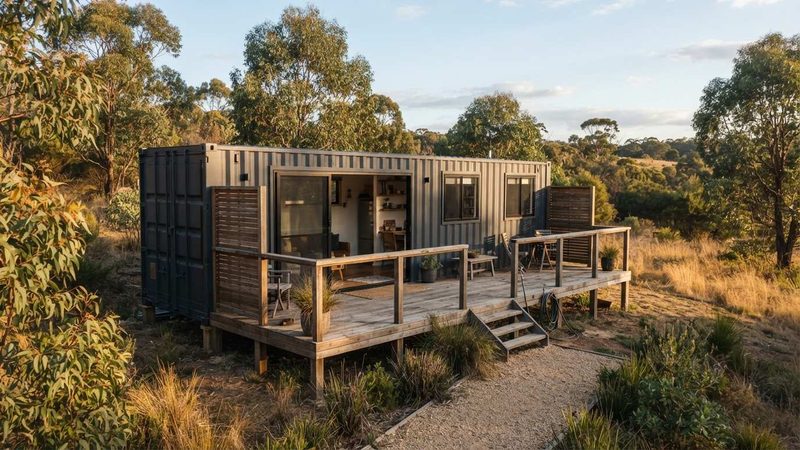
In every Great Home Ideas container build, the outdoor deck does more work per dollar than any other element. A well-designed deck attached to the container’s long wall creates an outdoor room that effectively doubles usable living space at a fraction of the per-square-metre cost of enclosed construction. In the ultimate budget context, the deck is not a luxury addition — it is the design move that makes the budget work, because 320 sq ft alone is too small to function as a complete home for most people.
| Deck Option | AUD Cost | Area Added | Cost/sqm |
|---|---|---|---|
| Basic treated pine (8ft × 16ft, owner-built) | $1,500–$3,000 | ~12 sqm | $125–$250 |
| Hardwood (Merbau, spotted gum) | $2,500–$5,000 | ~12 sqm | $208–$417 |
| Composite decking (Trex, Modwood) | $2,000–$4,500 | ~12 sqm | $167–$375 |
| Gravel or compacted base (Phase 1) | $200–$600 | Unlimited | $15–$50 |
The long wall deck connected through one large sliding glass door is the single highest-impact outdoor living investment in a container build. Budget approximately $2,500–$4,500 AUD for a basic 8ft × 16ft pine deck connected to a 1.8m sliding glass door opening. Compare: enclosed construction costs $350–$700+/sqm in Australia; the deck costs $125–$250/sqm.
08 — Services & UtilitiesThe Rural Build’s Biggest Variable
| Service | On-Grid Cost | Off-Grid Alternative | Budget Pick |
|---|---|---|---|
| Electricity | $2,000–$15,000+ (rural connection) | Solar + battery: $6,000–$15,000 | Compare total cost; rural sites >200m from grid, off-grid is often cheaper. See our solar guide. |
| Hot water | Electric: $600–$1,200 | LPG instantaneous: $400–$800 | LPG wins — lower cost, no electrical demand, consistent regardless of solar charge |
| Cooking | Electric cooktop: $300–$800 | LPG cooktop: $200–$600 | LPG — cheap, reliable, familiar; shares supply with hot water |
| Water supply | Mains: $1,000–$8,000+ | Rainwater tank + pump: $1,500–$4,000 | Rainwater standard for Australian rural builds; 5,000L adequate for single occupancy |
| Sewage | Council sewer: $2,000–$10,000+ | Composting toilet: $800–$2,500 | Composting toilet is lowest-cost permanent solution for rural single occupancy |
09 — Complete Budget Breakdown$45,000 AUD All-In
| Category | Tight (Owner-Builder) | Mid-Range | Notes |
|---|---|---|---|
| Container (40-ft, used WWT Grade B) | $3,500 | $5,500 | Inspect before purchase; Grade B best value |
| Delivery to site | $800 | $1,800 | Distance-dependent; negotiate with provider |
| Site preparation (grading, gravel pad, access) | $1,500 | $3,500 | Owner clearing where possible |
| Off-grid utilities (solar, LPG, rainwater, composting) | $6,000 | $12,000 | Largest variable; urban site with services dramatically lower |
| Container prep (rust treatment, primer, exterior paint) | $600 | $1,800 | Owner spray-painting saves $800–$2,000 vs professional |
| Openings (large door + entry + 2 windows + steel) | $2,500 | $5,500 | Licensed welder required; no DIY structural steel |
| Insulation (mineral wool batts + vapour barrier, DIY) | $1,500 | $4,000 | Owner installation; spray foam at upper end |
| Electrical (solar integration + subpanel + circuits) | $2,500 | $5,000 | Licensed electrician for final connection |
| Plumbing (wet room + kitchen + LPG hot water) | $2,500 | $5,500 | Licensed plumber for connection; owner trench work |
| HVAC (12,000 BTU mini-split) | $1,200 | $2,000 | DIY-install brands save $500–$1,000 |
| Interior fit-out (flat-pack kitchen, wet room tile, LVP floor) | $7,000 | $12,000 | Owner assembly and installation saves $2,000–$4,000 |
| Outdoor deck (8ft × 16ft pine, owner-built) | $1,500 | $3,000 | Highest-value DIY contribution in the entire build |
| Exterior finishing (paint, fascia, trim) | $600 | $1,500 | Owner spray-painting; one colour + one timber accent |
| Contingency (10%) | $3,180 | $6,310 | Rural builds always encounter site surprises; never skip |
| TOTAL | $34,980 AUD | $69,410 AUD | $45,000 AUD target requires owner-builder labour and disciplined mid-point decisions throughout |
The gap between $34,980 and $69,410 is almost entirely labour. Owner-builder contribution bridges this gap. Licensed trades remain essential for: structural steel (openings), electrical final connection, plumbing final connection. Owner-buildable without a license: land clearing; gravel pad; painting; flooring; cabinetry assembly; decking; all finishing carpentry. A motivated owner-builder can contribute 80–120 hours of semi-skilled labour worth $3,000–$6,000 in contractor costs. At $45,000 total, this contribution is structural to the budget — it is not optional.
Blueprint Sets for Budget Container Builds
Permit-ready plan sets from $29 on Amazon — material specifications, structural details, and cost schedules help get accurate contractor quotes.
Browse Blueprint Sets on Amazon →10 — Transferable LessonsWhat Every Budget Builder Can Apply
| Lesson | Evidence from the Build |
|---|---|
| The deck is the cheapest square metre you’ll ever build | A $2,500 pine deck adds usable living area at $125–$250/sqm vs $350–$700+/sqm for enclosed construction. Build outdoor space before premium interior finishes. |
| Flat-pack kitchens have closed the quality gap | At the right benchtop and tapware spec, a $4,000 flat-pack kitchen reads at $15,000+. The benchtop and tap are touched constantly; the cabinet boxes are largely invisible. Invest accordingly. |
| Wet rooms cost less and look more contemporary | Eliminating the shower screen saves $800–$2,500 and produces a better result. This is not a budget compromise in 2026 — it is correct design for a small bathroom. |
| One floor from end to end | A single LVP in a warm tone across the full 40-ft visually doubles the apparent width of the narrow container. Flooring transitions fragment the floor plan and make small spaces feel smaller. |
| Insulation is infrastructure, not a feature | Without adequate insulation, a steel box is uninhabitable in extreme conditions. It cannot be added efficiently after the interior is built. Treat it as foundational — not optional. |
| Build sequence is cost control | Site → foundation → container → openings → services → insulation → fit-out. Reversing this order creates rework costs that a $45,000 budget cannot absorb. |
| Understand total utility costs before buying land | A $45,000 build on a rural block with a $15,000 grid connection cost is immediately a $60,000 build. Off-grid is viable but must be budgeted from day one — not discovered after purchase. |